
Headache and migraine care in Newport Beach
Headaches that start at the base of the skull, sit behind one eye, or arrive at the end of a long day at a desk are often referred from the upper neck. That kind of headache responds well to chiropractic care.
5.0 ★★★★★ 681 Google reviews · Two doctors · Forty years in Newport Beach
Your first visit is $97 — consultation, exam, HRV scan, X-rays if needed, and your first adjustment.

Where the headache is coming from
The top three segments of the neck share nerve pathways with the covering of the head and face. When those joints stop moving well, or when the small suboccipital muscles at the base of the skull stay contracted for hours at a time, the brain can interpret the signal as head pain. This is called cervicogenic headache, and it is one of the most common presentations we see.
It has a recognisable shape. The pain usually starts at the base of the skull and spreads forward over one side; turning or holding the head in one position makes it worse; it is often worse late in the day rather than on waking; and it frequently comes with a neck that does not rotate equally in both directions.
Tension-type headache overlaps heavily with this pattern. True migraine is a separate neurological condition, but many people who have been told they have migraine also have a mechanical neck component that is contributing to frequency. Treating the neck does not treat migraine itself, though patients often report fewer episodes when the cervical component is addressed.
What we examine
We start with the history, because the pattern tells us most of what we need: where it starts, where it travels, what time of day, how long it lasts, what you were doing beforehand, and what has helped.
The examination covers cervical range of motion segment by segment, palpation of the suboccipital and upper trapezius musculature, jaw mechanics, and a posture assessment — head position relative to the shoulders is often the single most informative finding in desk workers. Where the history suggests it, we screen for signs that point away from a mechanical cause.
Imaging is taken on site only when the examination warrants it. The rest of the first visit is set out on what your first visit includes.
How we treat it
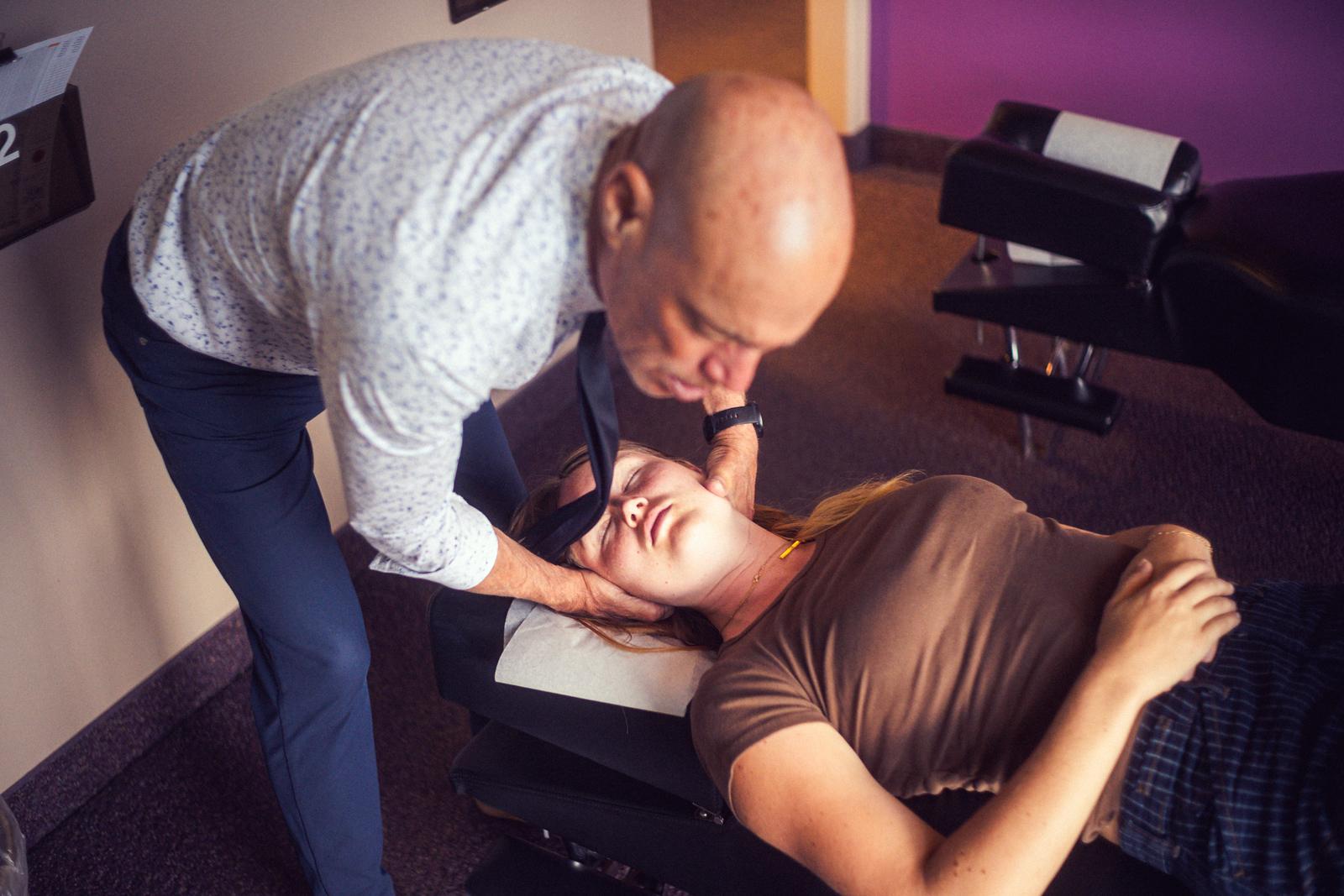
Adjusting restores motion to the upper cervical segments that are restricted. For patients who are wary of having their neck adjusted by hand — a common and reasonable concern — we use Activator instrument methods, which apply a small, precisely directed force without rotation.
Soft-tissue work to the suboccipital muscles, upper trapezius and jaw usually goes alongside it. Where an area is slow to settle, PEMF and muscle stimulation are available in the office and are described under services.
Between visits, the work is postural. Most desk-related headaches involve a monitor set too low, a chair that encourages the head to drift forward, and long stretches without moving. We give you two or three changes rather than a programme, and we check whether they have made a difference at the next visit.
What to expect
Headaches with a clear mechanical component often change within the first few visits — usually in frequency or intensity before they disappear altogether. Long-standing patterns take longer, particularly where the posture that drives them is fixed by a job.
We measure the same things each time: cervical rotation, tenderness, and your own count of how many headache days you have had since the last visit. That last number is the one that matters, and it is why we ask you to keep a rough record.
If the headaches are not responding, we say so and refer rather than continuing. Related pages: back and neck pain, and headache following a collision, which is common and has a different treatment and documentation path.
When a headache needs urgent assessment
Some headaches are not mechanical and need medical attention rather than chiropractic care. A headache that comes on suddenly and severely, one that follows a head injury, or one accompanied by fever and neck stiffness, visual loss, weakness, confusion or difficulty speaking should be assessed medically without delay.
A change in a long-standing headache pattern — new location, new severity, new associated symptoms — is also worth having checked. Our examination is designed to catch these presentations, and if yours fits one we will tell you at the first visit and help you get to the right place.
Triggers worth ruling out first
Before we treat, we look at the things that commonly drive headache frequency and are easier to change than anything mechanical: sleep that is short or broken, dehydration across a working day, caffeine taken late or withdrawn abruptly, meals skipped, and screen time in the two hours before bed. None of these are exotic, and all of them raise the baseline the mechanical problem sits on top of.
Jaw clenching deserves particular attention. It is common, it is usually unconscious, it worsens under stress, and it loads the same muscles that refer pain over the temple and behind the eye. Where we find it, we say so and refer to a dentist if a night guard is warranted — that is often the difference between partial and full resolution.
Medication overuse is the other pattern worth naming. Taking over-the-counter painkillers on most days can itself sustain a daily headache, and it needs to be unwound with your physician rather than by us.
Related pages: back and neck pain, post-collision headache, and headache during pregnancy, where treatment and medication options both narrow.
Can chiropractic help migraine?
Chiropractic care treats the mechanical neck component that often accompanies migraine rather than migraine itself. Many patients report fewer headache days when that component is addressed, but we will not claim to cure migraine and we will tell you if your presentation is not mechanical.
I do not want my neck cracked. Is there an alternative?
Yes. Activator instrument adjusting applies a small, precise force without rotation of the neck, and is our default for patients who prefer it. Tell us at the consultation and we will use it from the first visit.
How many visits before I know if it is working?
Most patients with a mechanical headache pattern notice a change in frequency or intensity within the first few visits. We re-examine and compare against your baseline rather than relying on impressions.
Do you take my insurance?
We accept Cigna, Blue Cross, United Health, Aetna, Coresource, Medicare, Optum and Coventry. Call (949) 250-0600 and we will check your benefits before you come in.
Where do I park?
There is free surface parking outside our suite at 20321 SW Birch St Ste 100, Newport Beach. The entrance is on the ground floor and the office is step-free from the lot.
Claim a time.
Details after.
Rated by 681 patients on Google · 40 years in Newport Beach · Most insurance accepted