
Auto accident injury care in Newport Beach
Whiplash symptoms often appear a day or two after the collision, once adrenaline drops. We examine, treat, and document findings properly for your claim from the first visit onward.
5.0 ★★★★★ 681 Google reviews · Two doctors · Forty years in Newport Beach
Your first visit covers the consultation, exam, HRV scan, X-rays if needed, and your first adjustment.
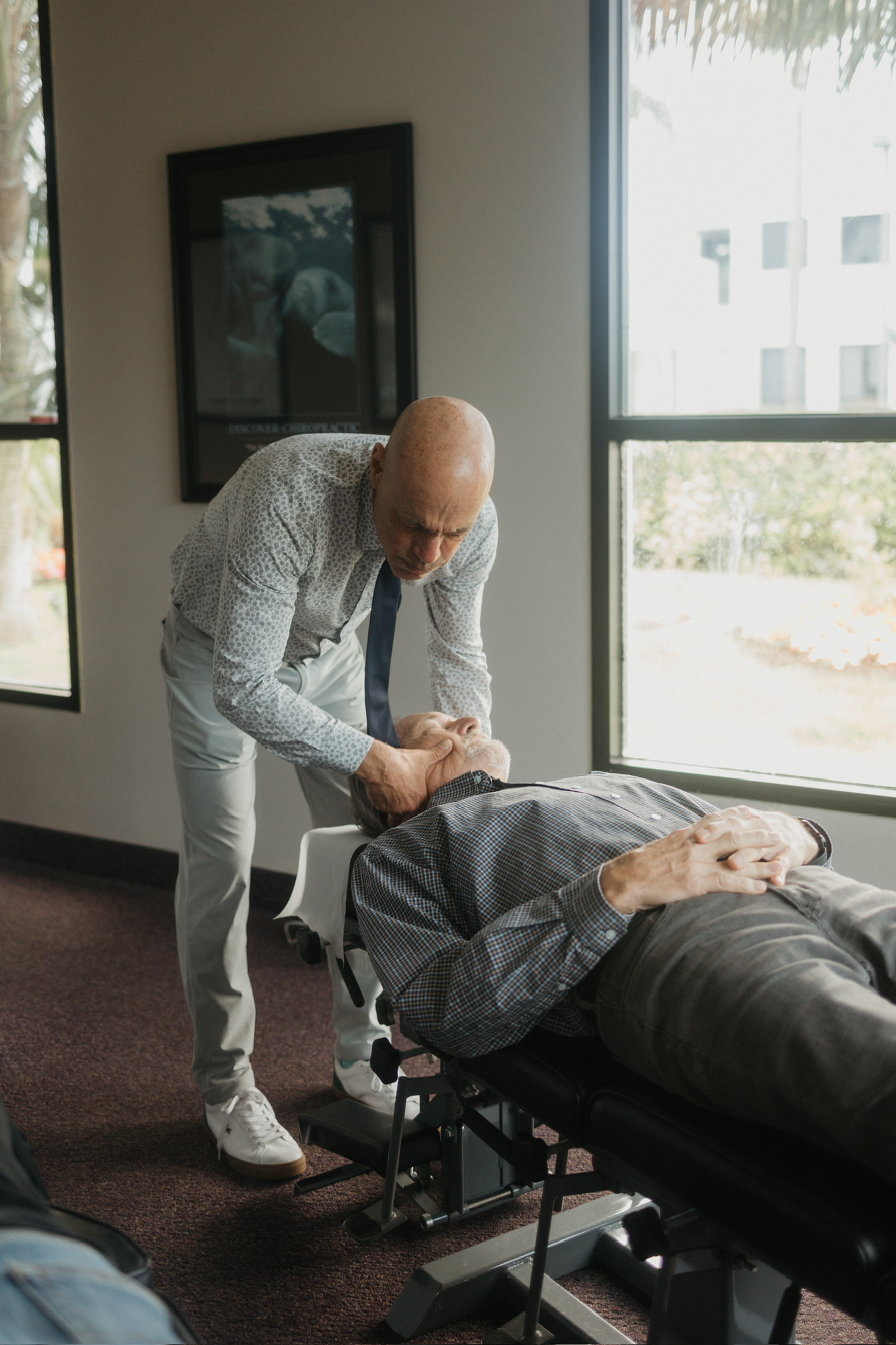
Why symptoms show up late
In the hours after a collision, adrenaline and inflammation mask a great deal. People routinely walk away from a low-speed impact feeling shaken but intact, then wake the next morning with a neck that will not turn, a headache at the base of the skull, and an ache between the shoulder blades.
The mechanism is straightforward. The head is heavy and sits on a mobile neck; in a collision it is thrown through a range of motion faster than the surrounding muscles can control. The result is strain to the soft tissue, irritation to the small facet joints, and a protective muscle response that limits movement for days or weeks afterward.
Speed is a poor predictor of injury. Low-speed impacts produce significant whiplash-associated symptoms routinely, particularly where the head was turned at the moment of impact or the collision came from behind without warning.
What we examine and document
The examination is the same careful process we use for any neck presentation — range of motion, palpation, orthopaedic and neurological testing — with one addition: everything is documented in a form that stands up to review by an insurer or an attorney.
That means baseline findings recorded at the first visit, objective measures repeated at set intervals, notes on functional limitations in your own words, and imaging where the examination warrants it. Post-collision presentations are one of the clearer indications for X-ray, and we take them on site.
Headache after a collision is common and is treated alongside the neck; the mechanism is described on headaches and migraines. Low back and leg symptoms after impact are covered on sciatica and disc injuries.
How treatment is staged
Early care is conservative. In the first days after a collision the priority is settling inflammation and restoring gentle movement, not forceful adjusting. We use low-force instrument methods, soft-tissue work, muscle stimulation and PEMF at this stage, all listed under services.
As the tissue settles, treatment moves toward restoring normal segmental motion in the neck and mid-back and rebuilding the deep neck flexor strength that whiplash reliably degrades. This is where most of the lasting improvement comes from, and it is the stage people most often abandon early because the acute pain has gone.
Throughout, we re-examine and compare against the baseline. That serves two purposes: it tells us whether the plan is working, and it produces the objective record your claim needs.
Insurance, claims and cost
We accept Cigna, Blue Cross, United Health, Aetna, Coresource, Medicare, Optum and Coventry. Medical payments coverage under an auto policy is common in California and frequently covers this care; if you are working with an attorney, we are used to coordinating records and reports.
Bring the collision report or claim number if you have one, plus any hospital or urgent care paperwork. If you do not have any of it yet, come in anyway — the examination is the time-sensitive part.
The first visit includes the consultation, examination, HRV scan, X-rays if needed and your first treatment; the full list is on what your first visit includes.
When to be assessed medically first
Go to an emergency department rather than a chiropractor if you lost consciousness, are vomiting, have severe or worsening headache, have weakness, numbness or difficulty speaking, or have midline neck tenderness following a significant impact.
The same applies to chest, abdominal or visual symptoms after a collision. Our examination screens for presentations that need imaging or medical assessment before any treatment, and if yours is one we will say so and help you get there.
The injuries that get missed
Neck pain after a collision is obvious. Several other consequences are not, and they are the ones that turn into long-term problems when nobody looks for them at the time.
Mid-back and rib pain from seatbelt loading is common and often dismissed as bruising when it involves the small joints where the ribs meet the spine. Jaw pain appears after impacts where the mouth was closed hard, and it refers into the temple in a pattern people describe as headache. Shoulder pain on the side of the seatbelt is frequent. Dizziness and difficulty concentrating in the days after impact need proper assessment rather than being written off as shock.
Low back and leg symptoms after a rear impact are also under-reported, particularly where the driver was braced. Where they appear, we assess them the same way we would any disc presentation — see sciatica and disc injuries for what that involves.
All of it gets documented, because a symptom recorded at the first visit is far easier to attribute to the collision than one raised three months later. Related: headaches and migraines, back and neck pain, and, if you were pregnant at the time of the collision, prenatal care alongside obstetric review.
How soon after a collision should I come in?
Within the first few days is ideal, even if symptoms are mild. Early examination establishes a baseline while the findings are clearest, which matters both clinically and for your claim.
Will my auto insurance cover this?
Medical payments coverage under an auto policy commonly covers chiropractic care in California. We also accept Cigna, Blue Cross, United Health, Aetna, Coresource, Medicare, Optum and Coventry. Call (949) 250-0600 and we will check before you come in.
Do you provide records for my attorney?
Yes. Findings are documented at every visit in a form suitable for insurer or attorney review, including baseline measures and repeated objective testing.
I feel fine. Do I still need an exam?
It is worth being examined. Whiplash symptoms frequently appear one to three days after impact, and an early baseline is more useful than one taken weeks later.
Where do I park?
There is free surface parking outside our suite at 20321 SW Birch St Ste 100, Newport Beach. The entrance is on the ground floor and the office is step-free from the lot.
Claim a time.
Details after.
Rated by 681 patients on Google · 40 years in Newport Beach · Most insurance accepted